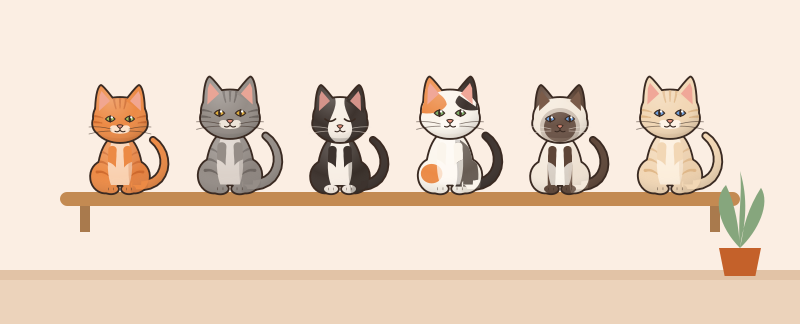
Black, white, ginger, grey. At first glance it looks simple. But as soon as you try to describe your cat, the questions start. Is it tabby or spotted? Calico or tortoiseshell? And what exactly do you call that grey?
Cat coat colours follow some fairly clear rules. Once you know them, you’ll look at cats differently. You’ll also be able to describe yours precisely, which is very useful if it ever goes missing.
Start with coat length
Before colour, look at the hair:
- Short hair. The most common.
- Semi-long hair. Long, but with less undercoat. Often with a ruff and a plumed tail.
- Long hair. Thick and abundant, like a Persian’s.
There are also hairless cats, like the Sphynx, and curly-coated cats, like the Rex breeds.
Basic cat coat colours
Cats have two base colours, black and red, which genetics can change:
| Colour | What it looks like |
|---|---|
| Black | deep black, sometimes rusty in the sun |
| Blue | an even grey; it is “diluted” black |
| Chocolate | warm, dark brown |
| Lilac | a pinkish grey; it is diluted chocolate |
| Red | what most people call ginger or orange |
| Cream | pale ginger; it is diluted red |
| White | in fact, white masks any other colour |
So the everyday “grey cat” is, in breeders’ language, a “blue” cat.
Coat patterns
Tabby
The oldest and most common pattern. All tabbies have an “M” marking on the forehead. There are four main types:
- Mackerel: thin, parallel stripes down the sides, like a tiger.
- Classic or blotched: wide swirls on the sides, like a target.
- Spotted: spots instead of stripes.
- Ticked: no stripes on the body; each hair has bands of colour. You’ll see it in the Abyssinian.
Bicolour
Any colour with white. It can be a little white, like a black cat with white socks, or a lot of white with just a few patches of colour.
Tortoiseshell and calico
A tortoiseshell mixes black and red in small patches or brindled together. A calico is the same with large white patches added. In diluted versions, black becomes blue and red becomes cream.
Colourpoint
The body is pale and the extremities are dark: ears, face, legs and tail. The eyes are blue. It is the Siamese pattern. It happens because the colour only develops fully on the cooler parts of the body.
Smoke
Each hair is white at the root and dark at the tip. When the cat moves, the pale base shows through.
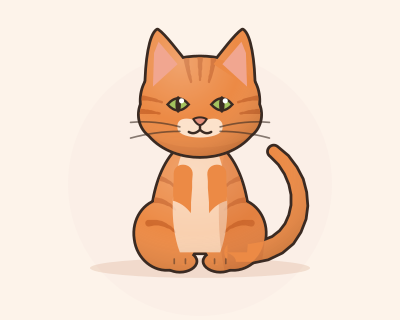 TabbyStripes, swirls or spots, and an “M” on the forehead.
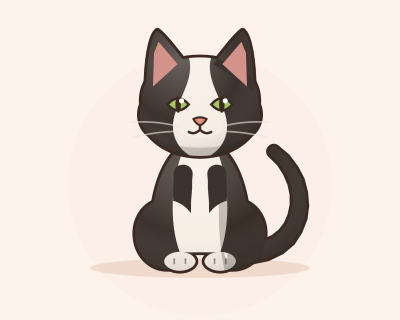 BicolourAny colour with white.
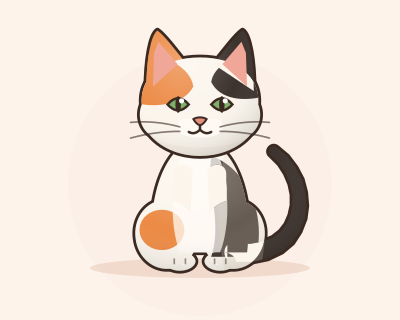 Tortoiseshell and calicoBlack and red patches; calico adds white.
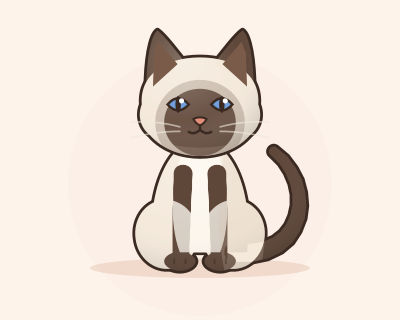 ColourpointPale body, dark face, ears, legs and tail.
Everyday names you’ll hear
Alongside the official terms, people use plenty of everyday names. A tuxedo cat is black and white, with a white chest and paws. A ginger is a red tabby. A torbie is a tortoiseshell with tabby stripes. And a van pattern means a mostly white cat with colour only on the head and tail.
The coat changes over time
A cat’s coat isn’t fixed. Many tabby kittens lose some of their markings as they grow. Colourpoints darken with age. In winter the coat gets thicker, and in spring it sheds heavily. Black cats that lie in the sun a lot can turn slightly rusty. Take photos through the year and you’ll see the changes.
Why tortoiseshells are almost always female
Red and black are carried on the X chromosome. To show both colours at once, a cat needs two X chromosomes, which normally only females have. That is why tortoiseshell and calico cats are nearly always female.
Ginger cats, on the other hand, can be male or female, but more of them are male.
And eye colour?
Cats’ eyes can be yellow, copper, green, hazel or blue. Some cats, especially white ones, have one eye of each colour. Eye colour isn’t directly linked to coat colour, except in colourpoints, which always have blue eyes.
White cats and blue eyes
Some white cats with blue eyes are born deaf, in one ear or both. Not all of them, but the risk is higher. If you have a white cat, notice whether it reacts to sounds. If not, you can adapt: for example, approach so it can see you coming.
Does colour affect personality?
You often hear that ginger cats are friendlier or that tortoiseshells are feisty. These are popular beliefs. There is no solid evidence that colour shapes personality. Socialisation, life experience and each cat’s own nature matter far more.
How to describe your cat well
A good description follows this order: pattern, colour, white. For example: “brown mackerel tabby with white” or “dilute tortoiseshell”. Then add the unique details: a spot on the nose, one white sock, a ringed tail. That makes your cat recognisable among thousands.
Colour affects care too: white cats can get sunburnt ears. See our guide to everyday cat care. And if your cat looks like a particular breed, read our guide to cat breeds.
Frequently asked questions
Can calico cats be male?
Very rarely, due to a genetic variation. These males are usually sterile.
Does a kitten’s eye colour change?
Yes. All kittens are born with blue eyes. The final colour appears during the first months.
Is a grey cat the same as a blue cat?
Yes. “Blue” is the technical name for an even grey coat in cats.
Sources & editorial note
- FIFe — Tabby patterns, general part of the standards
- FIFe — Breeds
- International Cat Care — Inherited deafness in white cats
Prepared by Miauly from the sources listed above, checked on 19 October 2026.